
Introduction — why light matters (and what the data tells us)
Have you ever wondered whether the light in your barn is helping or hurting your herd? Cow lighting is a deceptively simple thing until you look at the numbers: studies show controlled lighting can improve milk yield by up to 10% and reduce stress markers in dairy cows. As an engineer who’s kept a close eye on farm systems (and as someone who’s tripped over more than one trough), I find the question both practical and philosophical: what trade-offs are we accepting when we choose one lamp over another?

I’ll be honest — I don’t believe there’s a single “perfect” answer for every farm. Instead, we should weigh behavior, photoperiod management, and energy efficiency. Photoperiod and lux targets influence cow physiology; color temperature affects activity cycles. So: how do we balance biology, budget, and hardware? Let’s unpack that carefully, step by step, and keep the tinkering to a minimum where it counts.
Next, I’ll take apart common approaches and point to where the real problems hide — not the obvious wiring issues, but the things that quietly cost you milk and peace of mind.
Part 2 — Where traditional solutions fall short (the hidden pains)
I start with led cattle shed lighting because it’s become the default recommendation — yet default isn’t always right. Many barns swap incandescent or fluorescent fixtures for LEDs and call it modernized. But simply changing lamps without rethinking placement, photoperiod control, or power management often produces disappointing returns.
Here are the deeper problems I see on farms. First, a mismatch between lux levels and cow activity zones: animals need brighter light in feeding lanes and softer light in resting areas. Second, color temperature is overlooked — cool white is great for workspaces but can disrupt circadian cues for cows. Third, integration failures: motion sensors, dimmers, and power converters are often cobbled together, causing flicker or inconsistent output that stresses animals. Add in neglected wiring and you get hotspots or dark corners where cows avoid — that reduces feeding time and, eventually, milk yield. Look, it’s simpler than you think when you map light to behavior.
Why do these flaws persist?
Because farmers are busy and installers often treat lighting like a commodity. Edge computing nodes or basic automation systems are rarely used to enforce photoperiod schedules, so you end up with suboptimal on/off timing. The result: good hardware, poor outcomes. I’ve seen excellent LED fixtures ruined by bad control logic; it’s frustrating because the fix is usually process, not kit.
Part 3 — New principles and practical steps for better barn lighting
Looking forward, I favor a principles-first approach rather than gadget-chasing. Start with goals: stable photoperiod, zoned lux targets, and energy efficiency. Then choose components — fixtures, drivers, and sensors — that support those goals. For example, dimmable LEDs with consistent color-rendering index let you emulate dawn and dusk; pairing them with reliable power converters and simple controllers gives you repeatable cycles. When I design systems, I treat lighting like climate control: scheduled, measured, and adjustable.
What’s next for farm lighting? Integrating modest automation — not a full IoT overhaul, just dependable timers and ambient sensors — yields big behavior wins. Use lux meters to verify zones, set color temperature around 3000–4000K for most barns, and maintain a clear photoperiod (14–16 hours light for dairy production is common). — funny how that works, right? The technology is mature; the challenge is aligning it with animal care and routines.
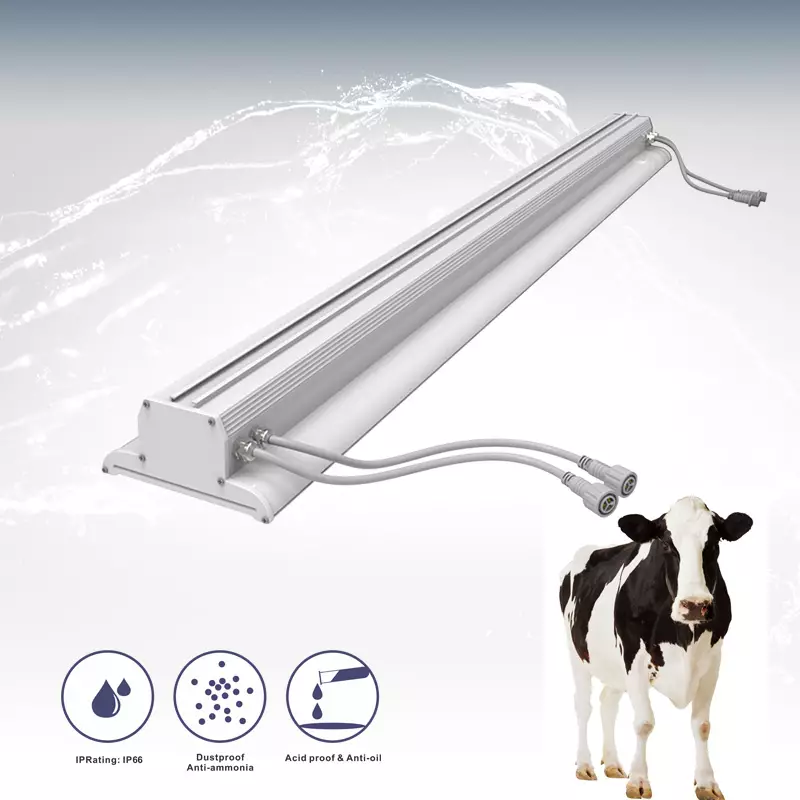
Real-world impact
In practice, farms that pair thoughtful layout with straightforward controls see measurable improvements: better feed intake, steadier milking behavior, and lower energy bills. I’ve helped operators move from ad-hoc fixtures to systems that log simple metrics and produce consistent results. If you want reliable returns, focus on repeatability rather than flash. For product options and practical fixtures, I often point people toward trusted suppliers of led cattle shed lighting — they’ve got sensible choices that don’t demand a PhD to install.
Closing — three metrics I use when recommending solutions
Here are three evaluation metrics I insist on when choosing a lighting solution: 1) zonal lux conformity — can the system meet target lux in feeding, walking, and resting zones? 2) control reliability — are timers/dimmers repeatable and resilient, or will they drift? 3) lifecycle cost — not just upfront price, but energy, maintenance, and replacement over time. I rank candidates against these metrics and favor systems that score consistently, even if they’re not the cheapest option. I’ve learned the hard way that cheap, inconsistent lighting costs more in the long run — emotionally and financially. We want herd calm and predictable production. That’s the goal.
If you’re comparing systems, note those three points, and you’ll avoid common traps. And yes — I still get excited when a simple rewire reduces animal stress. Small wins matter. For practical gear and a starting catalog, see szAMB.