
Why a framework matters for sourcing locally
Choosing a local partner for a wood panel saw machine requires more than price comparison; it needs a repeatable decision path that balances production needs, service reliability and long-term tooling strategy. In practical settings — for instance, the furniture clusters around Bengaluru’s Peenya industrial estate — shops that use a disciplined selection framework reduce downtime and improve yield. Early in the process, review the adjunct equipment too: a reliable cnc drilling machine in the same vendor ecosystem often signals stronger after-sales capability and better installation coordination.

Step 1 — Define the production envelope
Capture the facts: batch sizes, panel dimensions, cycle times, and tolerance requirements. Translate those into machine specifications such as maximum panel width, available cutting length, blade kerf tolerance and required feed rate. Include common industry terms to keep suppliers aligned — spindle power, axis travel and fixture compatibility — and specify whether the partner must support additional modules like edge banding or an integrated dust extraction system.

Step 2 — Assess local service and spare parts logistics
Local proximity is meaningful only when backed by trained service engineers and stocked spares. Request documented response-time commitments and a list of consumables they keep on hand. Look for partners who can demonstrate recent installations nearby — a site visit in the same city or industrial area can reveal real competence quickly. If a vendor also supplies an automatic drilling machine, that often translates to a more mature supply chain for drill bits, tool holders and controllers.
Step 3 — Verify control systems and software compatibility
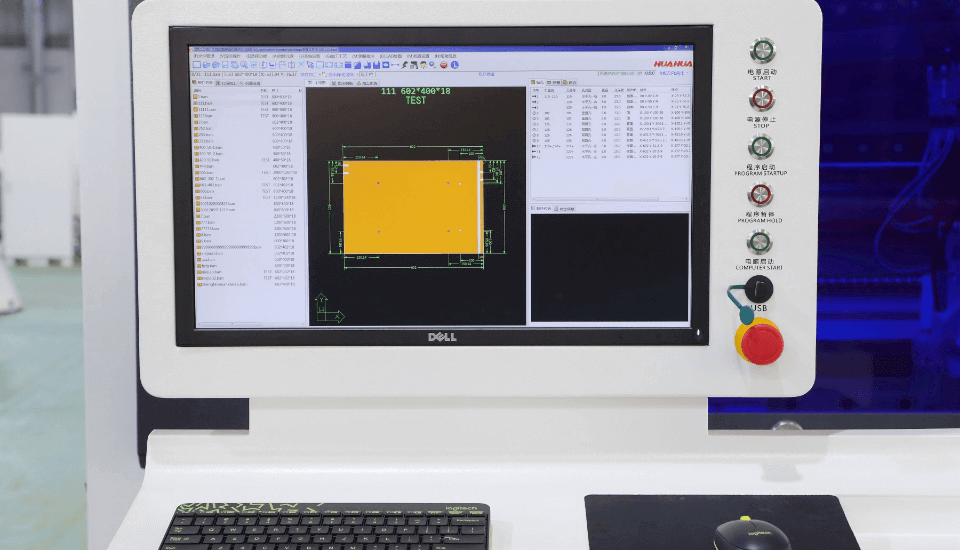
Confirm controller type, supported file formats and whether nesting software is included or optional. Compatibility with your existing CAM workflow saves time; insist on a brief demonstration using one of your typical jobs. Evaluate the human-machine interface and available diagnostics: readable error codes and a clear servo-axis status display reduce troubleshooting time. Controllers that expose spindle metrics and feed rate logs make continuous improvement feasible.
Step 4 — Field validation and reference checks
Insist on at least two reference visits. Ask about uptime statistics and maintenance history rather than general praise. Examine real outputs for edge quality and dimensional consistency on laminated panels, MDF and plywood. Note whether the partner trains your operators on routine checks — belt tension, blade alignment and watchdog routines for limit switches — and whether training documentation is handed over.
Common mistakes to avoid
Suppliers are often chosen on headline price alone; that ignores lifecycle costs like replacement blades, controller upgrades and annual calibration. Avoid informal verbal guarantees — secure service-level commitments in writing. Do not conflate a glossy brochure with proven local performance. Finally, do not overlook safety interlocks and CE-like design features; they tend to be costly to retrofit.
Operational teardown: what to test during acceptance
During handover, run a five-point acceptance protocol: precision cut lengths across full panel width, repeatability over 100 cycles, measured kerf variance, noise and dust behavior under production rate, and controller error recovery. Log spindle RPM stability, inspect fixture repeatability and verify that axis backlash remains within tolerance after continuous operation. These checks connect specification to reality and expose gaps early.
Summarised guidance for decision-makers
Gather documented specs, check local references, validate software fit and confirm spare-part logistics. The framework reduces subjective judgement and creates measurable acceptance criteria. It also clarifies how the vendor will support integration with existing shopfloor equipment like nesting software and auxiliary drilling or routing stations.
Three golden rules for selecting the right partner
1) Measurable uptime commitments: insist on response-time SLAs and a replacement-parts list. 2) Proof of local installs: visit references in the same region to verify service quality and operator training. 3) Integrated systems compatibility: ensure the wood panel saw machine, CNC router or drilling fixtures use compatible control protocols and tool libraries; that lowers integration months — not weeks. These are the real evaluation metrics that separate a short-term purchase from a durable production partnership.
Choose a partner who matches your operational rhythm — and who will tune that rhythm with you. — HUAHUA CNC